Roo Code
Use Roo Code with FinOps to access any AI provider through a powerful VS Code extension with virtual keys and observability.
Roo Code is an AI-powered VS Code extension that supports OpenAI-compatible APIs. By connecting it to FinOps, you get access to any provider/model in your FinOps configuration, plus governance features like virtual keys and built-in observability.
If your Allowed Headers are already set to *, you can skip this note. If not and you face issues integrating FinOps with Roo Code, try switching to * or adding the specific headers required by your client. By default, FinOps whitelists: Content-Type, Authorization, X-Requested-With, X-Stainless-Timeout, and X-Api-Key.
Setup
1. Install Roo Code
Install the Roo Code extension from the VS Code marketplace.
2. Create an API Configuration Profile
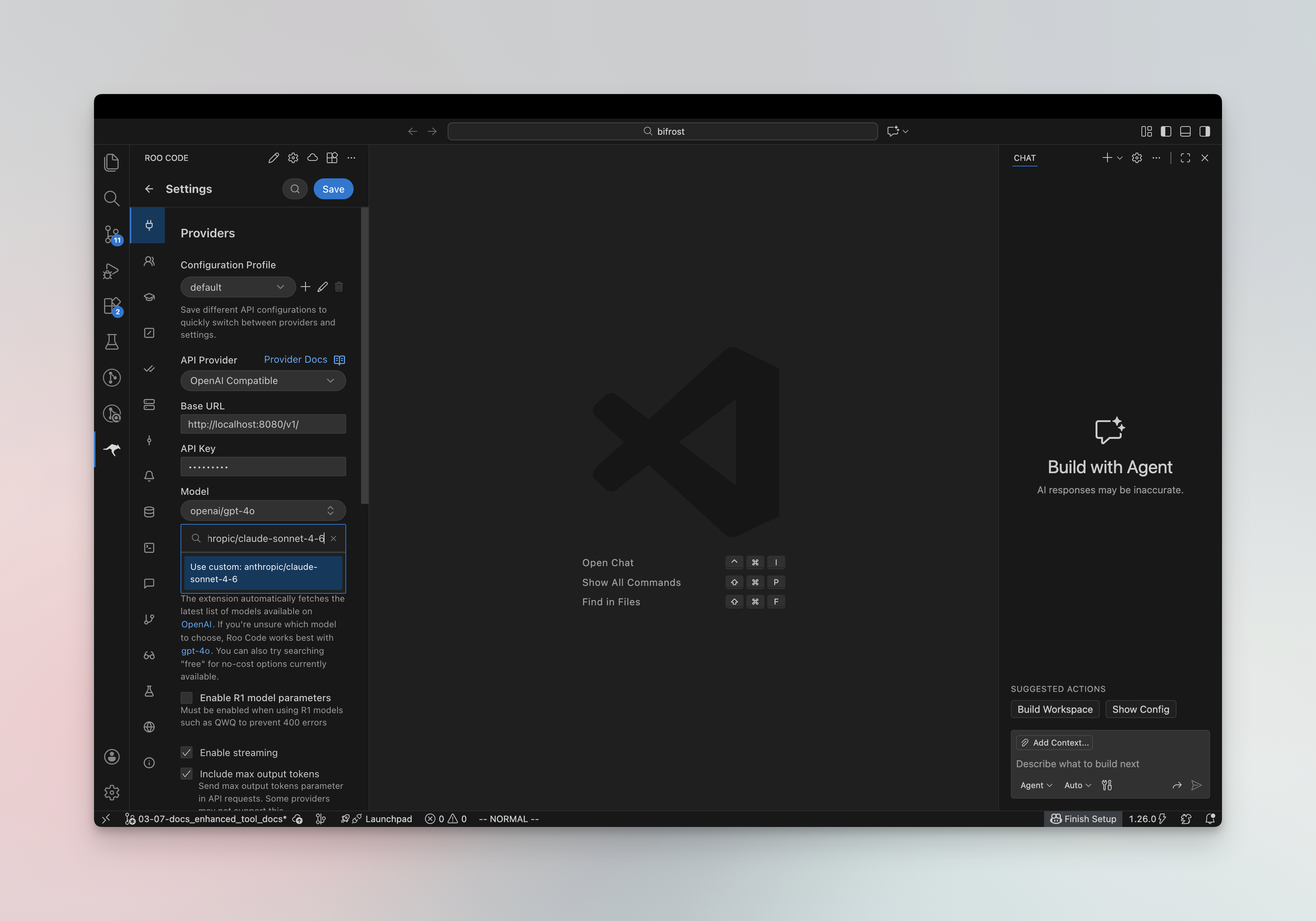
- Open Settings (click the gear icon) → Providers
- Click the + button to create a new profile
- Select OpenAI Compatible as the provider
- Configure the following:
| Field | Value |
|---|---|
| Base URL | {AI_GATEWAY_URL}/openai (or your FinOps host, e.g. https://finops.yourcompany.com/openai) |
| API Key | Your FinOps virtual key if authentication is enabled; otherwise use dummy or leave empty |
| Model | FinOps model ID in provider/model format (e.g. anthropic/claude-sonnet-4-5-20250929, openai/gpt-5) |
3. Verify the Connection
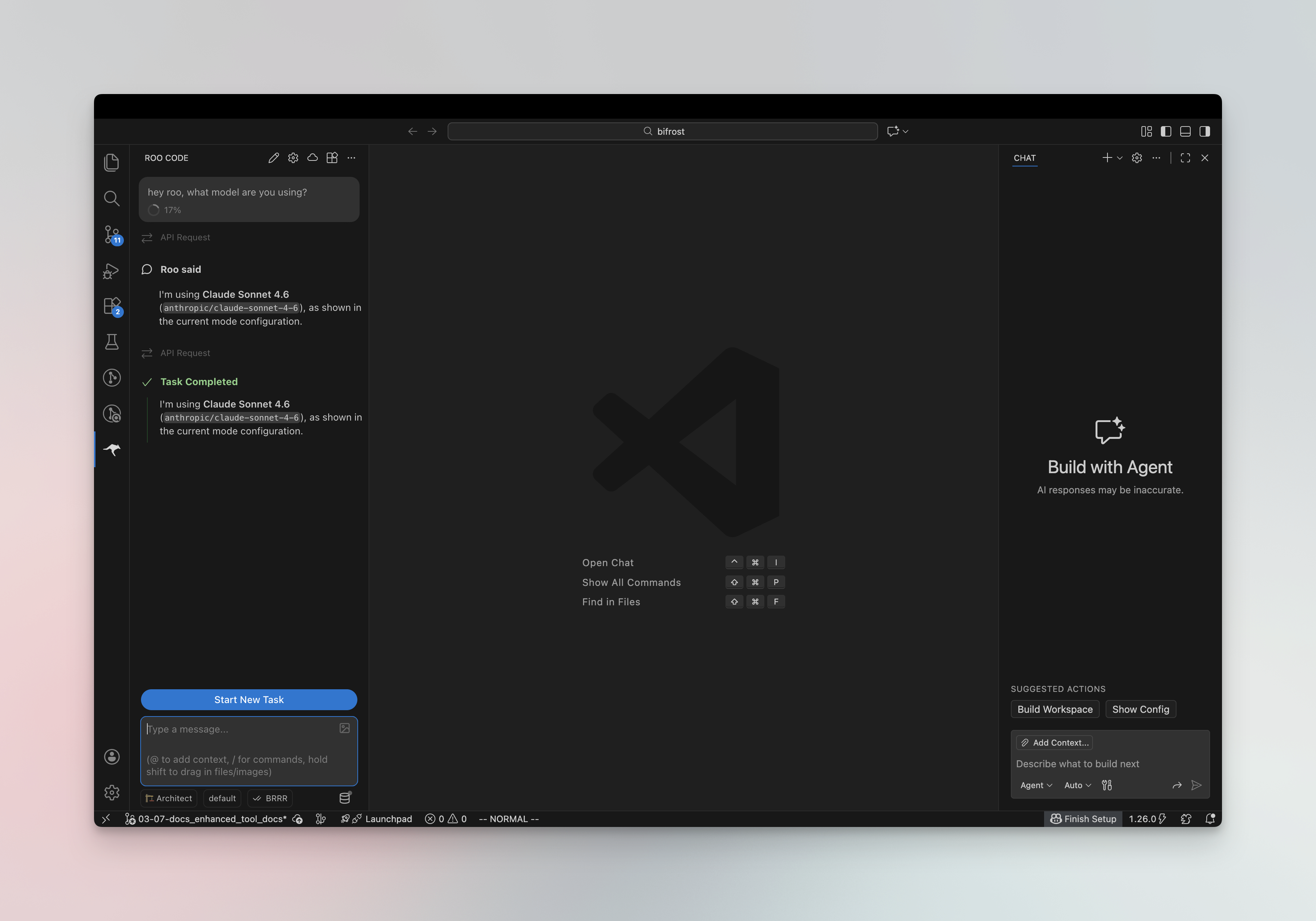
Ask Roo which model it's using - it should respond with the FinOps model ID you configured (e.g. anthropic/claude-sonnet-4-5).
Roo Code supports multiple API configuration profiles. Create separate profiles for different FinOps virtual keys or model combinations, then switch between them via the profile dropdown in Settings or during chat.
Virtual Keys
When FinOps has virtual key authentication enabled, set API Key in your Roo Code profile to your virtual key. This lets you enforce usage limits, budgets, and access control per user or team.
For team deployments, create a separate configuration profile for each team - each can use a different virtual key with its own rate limits, budgets, and provider access rules configured in the FinOps dashboard.
Model Selection
Roo Code lets you assign models per mode (Code, Ask, Architect, Debug, Orchestrator). Use FinOps model IDs in provider/model format to access any configured provider:
- Use powerful models like
openai/gpt-5oranthropic/claude-sonnet-4-5-20250929for complex coding tasks - Use fast models like
groq/llama-3.3-70b-versatilefor quick completions - Link different profiles to different modes in the Prompts tab for optimal cost and performance
Using Multiple Providers
FinOps routes requests to the correct provider based on the model name. Use the provider/model-name format to access any configured provider through the single OpenAI-compatible endpoint:
anthropic/claude-sonnet-4-5-20250929
openai/gpt-5
gemini/gemini-2.5-pro
mistral/mistral-large-latest
Supported Providers
FinOps supports the following providers with the provider/model-name format:
openai, azure, gemini, vertex, bedrock, mistral, groq, cerebras, cohere, perplexity, xai, ollama, openrouter, huggingface, nebius, parasail, replicate, vllm, sgl
Roo Code requires native tool calling (OpenAI-compatible function calling). Models without tool use support cannot be used with Roo Code. Ensure the model you select supports tool calling.
Roo Code connects to FinOps via a single OpenAI-compatible endpoint. FinOps handles routing to the correct provider based on the model name - no per-provider configuration needed.
MCP Server Integration
Roo Code supports MCP (Model Context Protocol). You can connect it to FinOps's MCP server to access all tools configured in FinOps. See MCP Gateway URL for setup instructions.
Observability
All Roo Code traffic through FinOps is logged. Monitor it at {AI_GATEWAY_URL}/logs - filter by provider, model, or search through conversation content to track usage.
Next Steps
- Provider Configuration - Configure AI providers in FinOps
- Virtual Keys - Set up usage limits and access control